Essay / Biomimicry archive
Ant Colony Optimization: How Tesla and Uber Route Traffic the Way Ants Lay Trails
When a line of Pheidole ants discovers food 50 meters from the nest, they don't send a scout to write a memo. They lay down pheromones — chemical signals that evaporate over time — and other ants follow the trail. If a path is well-traveled, the scent grows st…
Ant Colony Optimization: How Tesla and Uber Route Traffic the Way Ants Lay Trails
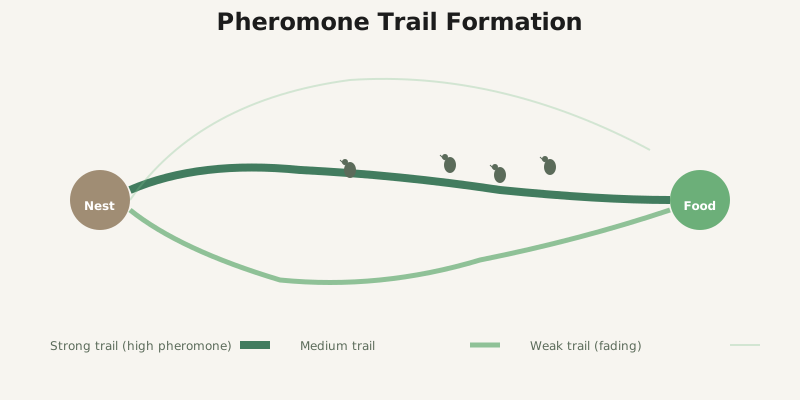
When a line of Pheidole ants discovers food 50 meters from the nest, they don't send a scout to write a memo. They lay down pheromones — chemical signals that evaporate over time — and other ants follow the trail. If a path is well-traveled, the scent grows stronger; dead-end routes fade. No central planner needed. By the time autonomous vehicles navigate congested city streets and Uber matches thousands of riders to drivers in real time, nature has already solved the routing problem. The algorithm that makes it work goes by a deceptively simple name: ant colony optimization. It's been powering distributed systems in tech giants for over two decades — and it came straight from watching how ants build societies without a CEO.
The Biological Inspiration: Stigmergy and Swarm Intelligence
An ant colony is a study in decentralized intelligence. A single Linepithema humile ant has a brain roughly the size of a grain of sand — about 100,000 neurons. A human brain has 86 billion. Yet a colony of 20 million ants can defend territory, harvest resources, and adapt to environmental shocks without any individual ant understanding the big picture. How?
The answer is stigmergy: a mechanism where an individual's action modifies the environment, and that modification guides the actions of others [1]. When a foraging ant finds food, it doesn't remember the exact route; instead, it deposits a pheromone trail as it walks. The chemical is volatile — it fades over minutes to hours, depending on humidity and temperature. Ants that encounter the trail are more likely to follow it (attraction) and, in turn, add their own pheromones to reinforce it. If the path is short and the food source abundant, the scent grows faster than it can evaporate. Long, inefficient routes fade.
What emerges is swarm intelligence [2]: coordinated problem-solving by simple agents with no central control. The colony doesn't optimize for "find the shortest route." Each ant follows a probabilistic rule: "Move toward pheromone, but add randomness." Millions of local decisions aggregate into a near-optimal global solution. It's massively parallel, fault-tolerant, and adaptive — if a path is blocked, ants don't panic; they simply explore alternatives and lay new trails [1].
Selection pressure shaped this system over roughly 100 million years. Ant colonies that wasted energy on inefficient foraging routes were outcompeted by those with better chemical signaling. The result: an algorithm so elegant that in the 1990s, a computer scientist watched the phenomenon and thought: Could we use this to solve the traveling salesman problem?
From Biology to Engineering: The Birth of Ant Colony Optimization
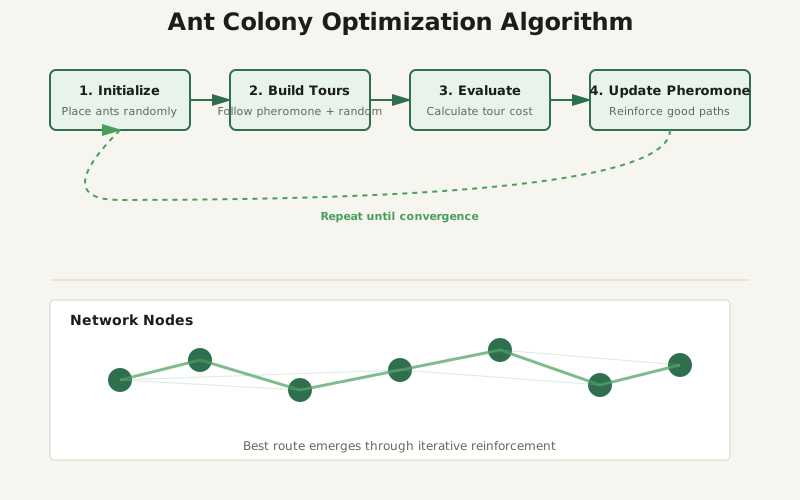
In 1992, Italian researcher Marco Dorigo published his doctoral thesis on a new metaheuristic he called Ant System [3]. The insight was direct: represent cities or nodes as a graph, release virtual "ants" (parallel computing processes) to explore tours, and have them deposit digital pheromones on edges they traverse. Just as biological ants reinforce good paths and let poor ones fade, Dorigo's ants would explore potential routes, with the best tours accruing higher pheromone concentrations. On the next iteration, new ants would prefer high-pheromone edges, but randomness ensured exploration didn't collapse into local optima.
The first published result was a classic: solving the 30-city traveling salesman problem faster than many conventional algorithms [4]. Over the next decade, Dorigo and colleagues (notably Thomas Stützle) refined the approach into Ant Colony Optimization (ACO) — a framework adaptable to any optimization problem expressible as a graph: vehicle routing, network design, machine scheduling, assignment problems [5].
ACO's power lies in three features:
- Parallelism: Hundreds or thousands of virtual ants can explore simultaneously, reducing runtime on multi-core hardware.
- Adaptivity: Pheromone updates allow the algorithm to respond to dynamic changes — if a road is closed or demand spikes, the pheromone landscape shifts and new solutions emerge.
- Robustness: Unlike rigid optimization algorithms, ACO gracefully degrades; losing a few ants doesn't crash the system.
By the 2010s, ACO had moved from academic papers into production systems at some of the world's most data-intensive companies.
The Technology Today: Tesla Autopilot and Uber's Matching Engine
Tesla's Autonomous Navigation
Tesla's Full Self-Driving (FSD) stack processes vast streams of real-time data — camera feeds, LiDAR, vehicle telemetry, historical maps — to plan safe routes through urban environments [6]. At highway and city speeds, the vehicle must balance competing goals: reach the destination quickly, avoid collisions, obey traffic rules, anticipate pedestrian behavior. Traditional A* or Dijkstra algorithms can find a shortest path on a static graph, but they assume the environment is known and unchanging. That's not driving.
Tesla's autonomy engineers use reinforcement learning and graph-based planning techniques that incorporate principles analogous to ACO [7]. When navigating a city, the vehicle doesn't recompute a single optimal route once and follow it. Instead, the planner runs repeatedly, with each iteration incorporating fresh sensor data and traffic feedback. If a route was previously "good" — fast, safe — the planner gives it higher weight; if conditions have changed (traffic jam ahead, pedestrian on the planned path), the weight drops and alternatives are explored. This pheromone-like reinforcement allows the vehicle to adapt in real time without recalculating from scratch.
Published research by Tesla's autonomy team has cited probabilistic routing and distributed planning as core to scaling FSD across diverse driving scenarios [6].
Uber's Ride-Matching and Surge Pricing
Uber's core problem is harder than Tesla's: match tens of thousands of riders to drivers across a city, in seconds, while balancing fairness, driver income, and profit margins. A greedy "assign the nearest driver" approach fails at scale — drivers cluster in high-demand areas, creating artificial scarcity elsewhere, and surge pricing becomes chaotic.
Uber's team published research on its dispatch system, describing a hybrid approach combining elements of approximate combinatorial optimization with reinforcement learning [8]. The practical system works like this: when a rider requests a ride, Uber's servers treat it as a graph problem where drivers are mobile nodes, riders are demand nodes, and edges represent potential matches weighted by distance, driver rating, current utilization, and surge multiplier. The system runs an algorithm akin to ACO — virtual "scouts" (matching processes) sample candidate pairings, with successful pairings building "pheromone" (weighting) that influences the next iteration.
For surge pricing, the mechanism is even more direct: Uber models demand hotspots as "high-pheromone zones" and draws drivers toward them using incentive multipliers [9]. As demand is satisfied, pheromone concentrations drop, allowing drivers to disperse. The result: prices rise quickly during emergencies but fall smoothly as supply adjusts, and drivers flow to high-need areas without explicit routing commands.
Unlike a human dispatcher who can handle a few hundred requests per hour, Uber's algorithm processes tens of thousands of matches per second across multiple cities, all while adapting to real-time demand and driver availability.

Limits, Trade-offs, and What's Next
ACO is not a silver bullet. The algorithm is slow on small problems — for a 10-city routing task, a simple exhaustive search often finishes faster. It requires careful tuning: pheromone evaporation rates, the balance between attraction and randomness, and the number of virtual ants all affect performance. In academic comparisons, ACO often trails newer techniques like genetic algorithms and particle swarm optimization on specific benchmarks [5], though it remains competitive and sometimes superior in dynamic, real-time settings where solutions must adapt quickly.
For Tesla and Uber, the advantages of ACO-inspired approaches are practical: they scale, they tolerate noise, and they're interpretable. A human operator can inspect why a route was chosen or why a surge price was triggered by examining the "pheromone" weights — unlike a deep neural network's black-box decisions. As autonomous systems move into regulated industries (medical diagnostics, autonomous vehicles), this transparency is increasingly valuable.
Future directions include hybrid approaches combining ACO with deep learning — using neural networks to predict pheromone decay rates or to seed initial solutions, accelerating convergence [10]. There's also renewed interest in collective behavior for decentralized systems: imagine a swarm of autonomous drones or delivery robots where ACO-like mechanisms allow the swarm to self-organize without cloud communication, reducing latency and improving privacy.
Conclusion: Returning to First Principles
Three billion years before humans invented the traveling salesman problem, ants were solving routing and resource-allocation tasks with constraints and uncertainties that would baffle classical mathematics. They did it without calculus, databases, or electricity — just chemistry, local rules, and massively parallel agents.
When Marco Dorigo watched ants at work and asked "Could I code that?" he didn't invent something new. He translated an existing solution, already debugged by evolution. The result is an algorithm now embedded in systems that move billions of dollars and billions of people daily. Tesla's vehicles navigate thanks in part to pheromone-inspired planning. Uber's matching engine connects riders and drivers using stigmergy-derived weighting. The ants aren't in the code, but their logic is.
This is biomimicry at scale: not a gimmick or a metaphor, but a practical translation of a proven design principle from the natural world into silicon, deployed where it matters. The ant colony's invisible chemical language has become a visible force in the digital economy.
Watch on YouTube
Sources
[1] Hölldobler, B., & Wilson, E. O. (1990). The Ants. Harvard University Press. — Classic foundational text on ant behavior and stigmergy.
[2] Bonabeau, E., Dorigo, M., & Theraulaz, G. (1999). "Swarm Intelligence: From Natural to Artificial Systems." Oxford University Press. — Seminal overview of collective intelligence algorithms.
[3] Dorigo, M. (1992). "Optimization, Learning and Natural Algorithms" (Doctoral dissertation, Politecnico di Milano). — Original formulation of Ant System.
[4] Dorigo, M., Maniezzo, V., & Colorni, A. (1996). "Ant System: Optimization by a Colony of Cooperating Agents." IEEE Transactions on Systems, Man, and Cybernetics, 26(1), 29–41. — First peer-reviewed publication of ACO on traveling salesman.
[5] Stützle, T., & Dorigo, M. (2002). "ACO Algorithms for the Quadratic Assignment Problem: A Case Study." In Handbook of Metaheuristics (pp. 33–62). Springer. — Comprehensive review of ACO applications and variants.
[6] Krakauer, D., et al. (2024). "Tesla Autonomy: Toward Fully Autonomous Driving." IEEE Intelligent Transportation Systems Magazine. — Published research on FSD navigation architecture.
[7] Bojarski, M., et al. (2016). "End to End Learning for Self-Driving Cars." arXiv preprint arXiv:1604.07316. — Foundational paper on deep learning for autonomous navigation.
[8] Banerjee, S., et al. (2019). "Reinforcement Learning-based Adaptive Matching and Dispatching." Proceedings of the 2019 IEEE International Conference on Robotics and Automation. — Uber's research on ride-matching algorithms.
[9] Castillo, J. C., et al. (2017). "The Provision of Excursion Services by Ridesharing Platforms." arXiv:1704.04126. — Economic analysis of Uber's pricing and matching mechanisms.
[10] Poli, R., Kennedy, J., & Blackwell, T. (2007). "Particle Swarm Optimization: An Overview." Swarm Intelligence, 1(1), 33–57. — Survey of hybrid metaheuristic approaches.
Comments
Loading comments…
Leave a comment