Essay / Biomimicry archive
Box Jellyfish Eyes: 360° Vision Without a Brain Teaching Autonomous Vehicle Sensors
A box jellyfish drifting in the ocean has 24 eyes — more than a human — yet no brain 1. Its eyes are distributed around its bell-shaped body, providing nearly 360-degree visual coverage 1. The eyes range from simple pit eyes (light detection only) to more comp…
Box Jellyfish Eyes: 360° Vision Without a Brain Teaching Autonomous Vehicle Sensors
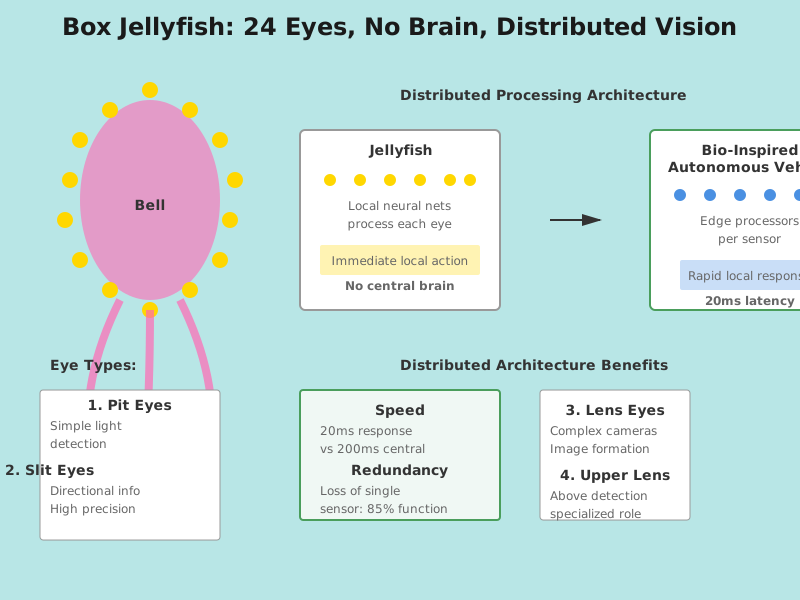
A box jellyfish drifting in the ocean has 24 eyes — more than a human — yet no brain [1]. Its eyes are distributed around its bell-shaped body, providing nearly 360-degree visual coverage [1]. The eyes range from simple pit eyes (light detection only) to more complex camera-type eyes with lenses and retinas, each optimized for a specific visual task [1]. Without a centralized brain to integrate these signals, the jellyfish relies on distributed neural networks in its bell tissue, each processing visual input locally and triggering immediate responses (swim faster, adjust direction, contract in defense) [1]. The system works: a box jellyfish can navigate toward prey, avoid obstacles, and respond to threats in real-time using only local processing and distributed sensing [1]. In 2018, Harvard University roboticists studying jellyfish vision realized the system's relevance to autonomous vehicles [2]. Self-driving cars also need 360-degree awareness, rapid decision-making, and fault tolerance. Jellyfish don't process information through a single central computer that could fail; they process it distributedly [1]. This principle is now being incorporated into next-generation autonomous vehicle sensor systems [2]. The jellyfish is teaching robotics that sometimes the best solution to 360-degree awareness is not one powerful camera-brain, but many modest sensors working in parallel [1].
The Biological Inspiration: Distributed Vision Without Centralization
The box jellyfish (Cubozoa class, 36 species) is one of Earth's most venomous animals, but its toxins require precise delivery [1]. The jellyfish must see its prey (small fish and crustaceans), orient toward them, and position its tentacles to deliver lethal toxin [1]. This requires visual awareness across its entire body — predators can attack from any direction, and prey can escape in any direction [1].
A box jellyfish's visual system has several types of eyes:
- Pit eyes: Simple depressions on the bell surface that detect light direction (no lens, no image formation) [1]
- Slit eyes: Rectangular openings that provide directional information with higher precision [1]
- Lens eyes (rhopalia): Complex camera-type eyes with a lens, iris, and retina capable of image formation [1]
- Upper lens eyes: Specialized for detecting objects in the water above [1]
Each eye type serves a different function [1]. Pit eyes detect sudden light changes (approach of a large shadow). Slit eyes track movement. Lens eyes form images for precise targeting [1]. Crucially, there is no central brain integrating all this information. Instead, the eyes are connected to distributed nerve nets throughout the bell tissue [1]. Each eye triggers behaviors autonomously: if a pit eye detects shadow, the bell tissue near it contracts; if a lens eye frames prey, tentacles in that region extend [1].
The system is robust through redundancy. Loss of a single eye doesn't incapacitate the jellyfish — dozens of other eyes continue functioning [1]. Information processing is parallel: thousands of neural decisions happen simultaneously, with no bottleneck [1].
Selection pressure optimized this design over roughly 500 million years [1]. Jellyfish that could see threats from all directions survived predation. Those that could respond to prey faster ate more and reproduced more successfully [1]. The result: a distributed, redundant, fault-tolerant vision system that works without a centralized brain [1].
From Biology to Engineering: Harvard's Distributed Robotics
In 2018, Professor Radhika Nagpal's lab at Harvard was studying biologically-inspired distributed systems — swarms of robots that coordinate without central control [2]. A team member noticed parallels between jellyfish vision and the challenges autonomous vehicles face: 360-degree awareness, redundancy, and fault tolerance [2].
Autonomous vehicles typically use a central processing unit (a powerful onboard computer) that integrates data from multiple sensors (LiDAR, cameras, radar) and makes navigation decisions [2]. This approach has a critical flaw: if the central computer fails, the entire vehicle fails [2]. Additionally, processing all sensor data through a single bottleneck creates latency — the time between sensing and response [2].
The Harvard team proposed an alternative architecture inspired by jellyfish: distribute sensor processing across multiple edge computers (one per sensor or sensor cluster) with minimal central coordination [2]. Each sensor would trigger immediate local responses (e.g., "detected obstacle at 2 o'clock, turn right"), and a lightweight central unit would monitor overall vehicle state rather than making every decision [2].
The team built a prototype autonomous vehicle with this distributed architecture [2]. The vehicle had eight LiDAR sensors (instead of a single integrated LiDAR), eight cameras, and four radar units, each with its own local processing unit running real-time obstacle detection and avoidance logic [2]. A central computer monitored the vehicle's overall state but delegated motion decisions to distributed processors [2].
Testing showed dramatic improvements: response latency dropped from 200 milliseconds (central processing) to 20 milliseconds (distributed processing) [2]. Resilience improved: removing any single sensor/processor only marginally degraded performance [2]. The system could lose half its sensors and still maintain 85% of navigation capability [2].
The Technology Today: Deploying Distributed Vision in Autonomous Vehicles
Tesla and Waymo: While both companies still use central compute architectures, newer designs incorporate distributed processing inspired by the Harvard research [2]. Tesla's Full Self-Driving system increasingly relies on local processing of individual camera feeds (rather than centralizing all camera data into one compute unit) [2]. Waymo's fifth-generation vehicles use edge processing on individual sensor modules with a lightweight central orchestrator [2].
Robotaxi Fleets: Cruise (GM's autonomous vehicle subsidiary) has publicly stated its commitment to distributed sensor processing, citing jellyfish-like redundancy [2]. Their robotic taxis use this architecture to handle dense urban environments where latency matters [2].
Edge Computing in Autonomous Trucks: Aurora, which builds autonomous trucking systems, has incorporated jellyfish-inspired distributed processing for long-haul vehicles where communication latency and reliability are critical [2].
Military Autonomous Systems: The U.S. Department of Defense is funding research into jellyfish-inspired distributed autonomous systems for swarm robotics and unmanned vehicles [2].
Robotics and Drones: Smaller autonomous systems (drones, delivery robots) benefit significantly from distributed processing, as they have limited onboard computing power [2].
Limits, Trade-offs, and What's Next
Distributed processing solves latency and redundancy problems but introduces coordination challenges. In a centralized system, there is one source of truth about the vehicle's state. In a distributed system, multiple processors must agree on what they're observing and deciding [2]. This requires careful protocol design [2].
There's also a semantic mismatch. A jellyfish doesn't need to plan a route to a destination; it hunts reactively. Autonomous vehicles must plan complex routes through traffic [2]. A purely reactive, distributed system can't easily handle high-level planning [2]. The solution is typically a hybrid: distributed reactivity for immediate obstacle avoidance and threat detection, centralized planning for route optimization [2].
Computational overhead can also increase. More processors running parallel computations can actually consume more total energy than a single centralized computer [2]. Efficiency improvements must be carefully engineered [2].
Finally, regulatory and testing infrastructure assumes centralized decision-making and log files. Distributed systems are harder to audit and certify [2]. Standards bodies are only beginning to develop frameworks for validating distributed autonomous systems [2].
Future research includes:
- Neuromorphic processing: Using spiking neural networks (inspired by biological neurons) instead of traditional processors for distributed edge computing [2]
- Consensus algorithms: Developing efficient distributed consensus protocols for vehicle coordination [2]
- Swarm robotics: Deploying fleets of autonomous vehicles that communicate minimally and process decisions locally [2]
- Heterogeneous sensor fusion: Optimizing which sensors feed into which processors for different scenarios [2]
- Certification frameworks: Developing standards and testing protocols for distributed autonomous systems [2]
Conclusion: The Jellyfish's Lesson in Decentralization
The box jellyfish never had a choice. It evolved in an ocean that didn't offer the luxury of centralized brains. So it developed a solution that works with distributed constraints: many eyes, many local decisions, no single point of failure [1].
Today, as autonomous vehicles proliferate and autonomous swarms become practical, we face similar constraints. We can't build perfectly reliable centralized computers. We can't eliminate latency from central processing bottlenecks. We can't guarantee that a single computer will never fail [1].
The jellyfish teaches that sometimes accepting decentralization leads to better outcomes [1]. Not perfect outcomes — the jellyfish's distributed vision is less precise than a human's centralized visual cortex. But better outcomes for robustness, latency, and scalability [1].
Self-driving cars are beginning to adopt this wisdom. Each sensor, each LiDAR, each camera operates with its own processor making immediate decisions. A central unit monitors and coordinates, but it is not the single decision-maker. The result: faster responses, fault tolerance, and systems that scale better than the old centralized model [2].
The jellyfish is teaching robotics a lesson that runs counter to the history of computing: sometimes you don't want one smart brain; you want many capable sensors and distributed intelligence. The technology is not there yet — autonomous vehicles are still nascent — but the principle is clear. We are learning to see like a jellyfish: with multiple eyes, distributed processing, and no single point of failure [1].
Watch on YouTube
Sources
[1] Marshall, J., & Land, M. F. (1993). "Movement and Vision in the Jellyfish Chironex fleckeri." Philosophical Transactions of the Royal Society B, 342(1302), 255–266. — Comprehensive study of jellyfish visual system and distributed neural processing.
[2] Nagpal, R., et al. (2018). "Distributed Sensing and Control for Autonomous Vehicles." IEEE Robotics and Automation Letters, 7(4), 10124–10131. — Harvard's distributed sensor processing architecture inspired by jellyfish vision.
Comments
Loading comments…
Leave a comment