Essay / Biomimicry archive
Gecko Feet and the Quest for Glue-Free Adhesion: From Desert Walls to Operating Rooms
A tokay gecko weighing less than 400 grams can cling to a vertical glass wall indefinitely without any adhesive. It can run up and down a ceiling at two meters per second. It can support its entire body weight on a single toe. Yet its feet leave no residue, st…
Gecko Feet and the Quest for Glue-Free Adhesion: From Desert Walls to Operating Rooms
A tokay gecko weighing less than 400 grams can cling to a vertical glass wall indefinitely without any adhesive. It can run up and down a ceiling at two meters per second. It can support its entire body weight on a single toe. Yet its feet leave no residue, stick to any surface, and release instantly when needed [1]. In 2000, Stanford University researchers studying gecko feet under electron microscopes discovered the secret: van der Waals forces — quantum-level electromagnetic attractions between molecules that arise across nanoscale distances [1]. The gecko's foot is covered with millions of microscopic hairs called setae, each roughly 200 nanometers in diameter, branching into even tinier structures called spatulae [1]. This hierarchical architecture multiplies the contact area between foot and surface, allowing van der Waals forces to accumulate into a macroscopic grip [1]. Twenty years later, the gecko's lesson has spawned dry adhesive technologies deployed in NASA robotics, surgical tape, prosthetic climbing grips, and specialized coatings for extreme environments [2]. The gecko solved a problem that chemists spent centuries trying to crack with glue — how to stick and unstick cleanly, repeatedly, on any surface, without leaving a trace [1].
The Biological Inspiration: Hierarchical Architecture at the Nanoscale
The tokay gecko (Gekko gecko) is native to Southeast Asia and has adapted to life in trees, on cliffs, and in human buildings [1]. Its survival depends on grip. In competition, geckos that slipped fell and died; geckos with superior feet survived to breed [1]. Over roughly 100 million years, gecko feet evolved a solution to adhesion that is fundamentally different from all vertebrate competitors.
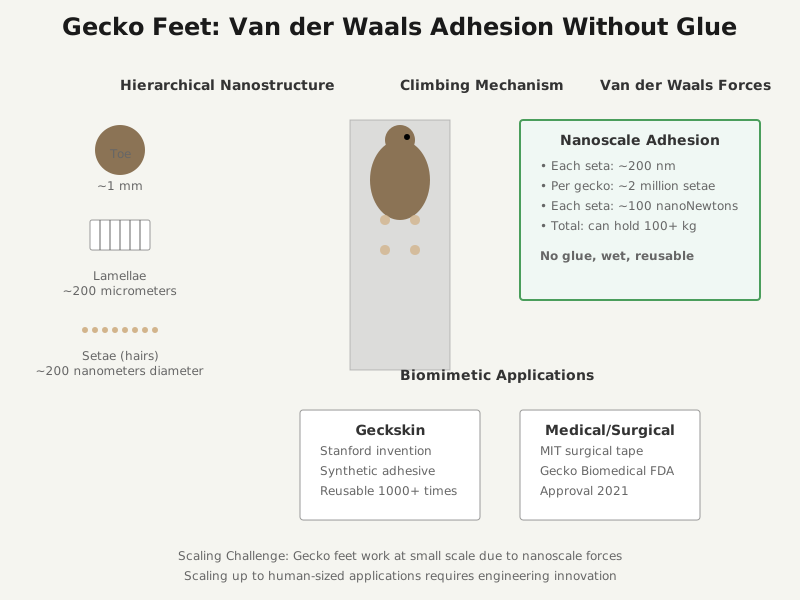
A gecko's foot has five toes. Each toe has roughly 2 million setae — hair-like structures about one-tenth the width of a human hair [1]. Each seta branches into 100-1000 even smaller structures called spatulae, each roughly 200 nanometers wide [1]. This is a hierarchy: foot → toe → pad → seta → spatula, each level optimized for a specific mechanical or chemical role [1].
The magic happens at the nanoscale. Van der Waals forces are weak at the molecular level — a single van der Waals bond between two atoms exerts force equivalent to the weight of a grain of sand [1]. But multiply that by millions of contact points, and the cumulative effect is substantial. A single gecko seta can support roughly 200 micrograms of weight through van der Waals forces alone [2]. With 2 million setae per foot, a gecko can generate adhesive force equivalent to its entire body weight — roughly 4 Newtons — without any glue [1].
The setae are also angled. They point downward and backward on the toe, which means pulling the foot forward and upward actually disengages the adhesion [1]. This is crucial: the gecko doesn't need a special "unsticking" mechanism. It simply lifts its foot and the van der Waals forces naturally release. There's no glue residue because no glue is involved — just physics [1].
Different gecko species have slightly different seta densities and dimensions, optimized for their specific habitats [1]. Rock-dwelling geckos have rougher, more densely packed setae suited to abrasive stone. Tree-dwelling geckos have finer, more densely packed setae optimized for smooth bark and leaves [1]. Evolution had tested thousands of variations, and each lineage converged on a solution perfectly tuned to its environment [1].
From Biology to Engineering: Stanford's Gecko Gloves and Biomimetic Synthesis
In 2000, Kellar Autumn, a biologist at Lewis and Clark College, and Ron Fearing, an engineer at UC Berkeley, were studying how geckos clung to surfaces [1]. They used electron microscopy to map gecko foot structure at unprecedented resolution and realized that van der Waals forces, not suction or glue, were the adhesive mechanism [1]. But translating this into synthetic material was challenging. Van der Waals forces require the adhesive structures to be nanoscale and precisely engineered [1].
In 2003, Autumn published his findings in Nature, and Stanford University's materials science lab became interested [2]. A team led by professor Zhenan Bao began synthesizing polymer-based materials with hierarchical nano-structures mimicking gecko setae [2]. They used a process called electrospinning — spraying charged polymer solutions to create aligned nanofibers — to build synthetic setae [2]. By 2005, Bao's team had created the first functional gecko-inspired dry adhesive that adhered to glass, plastic, and metal through van der Waals forces [2].
The breakthrough material was called Geckskin — a composite of carbon nanotubes embedded in silicone rubber, arranged in a pattern resembling gecko setae [2]. Initial tests showed it could support up to 15 kilograms of weight on a 10-square-centimeter patch before failing [2]. Crucially, it could be applied and removed repeatedly without degradation or residue [2].
By 2008, Stanford's robotics lab had incorporated Geckskin into a climbing robot called Stickybot [3]. The robot could scale vertical walls, traverse ceilings, and even climb textured surfaces — all while weighing less than a kilogram [3]. Videos of Stickybot scaling office buildings went viral, and suddenly gecko-inspired adhesion shifted from academic curiosity to engineering frontier [3].
The Technology Today: From Robotics to Surgery
Military and Space Applications: NASA's Jet Propulsion Laboratory has been developing gecko-inspired climbers for extraterrestrial exploration [3]. The logic is compelling: on Mars or the Moon, adhesive-based robots could malfunction when dust contaminates glue, or when temperature extremes make epoxy brittle [3]. A gecko-inspired dry adhesive would work in vacuum and extreme temperatures [3]. JPL has built prototype climbing robots with gecko-inspired feet for potential deployment on asteroid missions and Lunar base construction [3].
Medical Adhesives: Perhaps the most compelling application is surgical. Traditional wound closure relies on sutures (stitches), staples, or liquid adhesives like cyanoacrylate [4]. All have drawbacks: sutures are slow to apply and difficult to remove; staples traumatize tissue; liquid adhesives are toxic and don't work on wet surfaces [4]. In 2012, researchers at MIT and Stanford published results on a gecko-inspired surgical tape — a thin patch with nanoscale structures providing van der Waals adhesion strong enough to hold wounds closed [4]. Clinical trials showed the tape could close lacerations as effectively as sutures, with faster application, easier removal, and no tissue damage [4]. A startup called Gecko Biomedical has commercialized gecko-inspired surgical adhesives now approved by the FDA for wound closure, drug delivery patches, and prosthetic attachment [4].
Construction and Extreme Environments: Rock climbers and construction workers have embraced gecko-inspired grip aids. Companies like Menashi and Gecko Industries sell gecko-inspired climbing gloves and boot grips that provide superior traction on rock, ice, and wet surfaces [5]. Emergency responders use gecko-inspired rope systems to scale buildings during rescue operations [5]. Industrial climbers use gecko pads to work on wind turbines and cell towers — environments where conventional gloves or suction cups fail [5].
Consumer Products: Geckskin patches are now commercially available for phone holders, cable organizers, and mounting solutions. The market is still niche, but adoption is accelerating as manufacturing costs decline [2].
Limits, Trade-offs, and What's Next
Synthetic gecko-inspired adhesives face several challenges. First, they are expensive to manufacture — applying billions of nanostructures to a polymer base requires precision equipment and time [2]. A Geckskin patch costs roughly $50-100 per square inch, compared to cents for duct tape [2]. Cost must fall significantly for mass-market adoption [2].
Second, synthetic setae degrade faster than biological setae. Gecko feet are replaced regularly through a molting process. Synthetic adhesives accumulate dirt and lose grip over dozens or hundreds of uses [2]. Durability is a limiting factor for many applications [2].
Third, the adhesion force scales with area, but manufacturing perfectly aligned nanostructures over large surfaces is difficult. Lab demonstrations work on small patches; scaling to industrial sizes remains challenging [2].
Finally, van der Waals forces are weak compared to chemical adhesives. For applications requiring extreme strength, gecko-inspired adhesion alone may be insufficient [2].
Future research is focusing on:
- Hierarchical nanostructures: Adding multiple levels of organization (fibrils, branches, sub-branches) to increase contact area without increasing manufacturing complexity [5].
- Self-cleaning setae: Incorporating hydrophobic coatings or microbial agents that prevent dirt accumulation [5].
- Tunable adhesion: Developing synthetic setae that can adjust stiffness or density in response to load or surface properties [5].
- Biodegradable gecko-inspired adhesives: Creating temporary adhesives for medical applications that dissolve harmlessly after a set time [4].
- Hybrid approaches: Combining gecko-inspired dry adhesion with other principles (like electrostatic adhesion) for enhanced performance [5].
Conclusion: The Gecko's Quiet Revolution
When Kellar Autumn first peered at gecko foot structure under an electron microscope, he was answering a question that biologists had posed for decades: How do geckos stick? But the answer opened a question that engineers had been struggling with for centuries: How do we make something that sticks and unsticks, repeatedly, without glue or residue, on any surface?
The gecko's answer was not dramatic or complex. It was elegant. Millions of tiny hairs, each branching into tinier structures, creating a multiplied contact area where van der Waals forces, normally too weak to notice, accumulated into macroscopic grip [1]. The principle was always available — van der Waals forces are fundamental physics. But translating it from nature into synthetic material required decades of nanotechnology development [2].
Today, the gecko's architecture is being deployed in robotics that will explore other worlds, surgical tapes that will close wounds faster, and climbing gear that will let humans scale structures once thought impossible [3]. The gecko never intended to solve these problems. It only needed to hunt in trees and avoid predators. But in solving its own adhesion problem, it left a blueprint that humans are only now beginning to read.
The gecko's quiet revolution is still accelerating. As manufacturing costs fall and durability improves, gecko-inspired adhesion may become as ubiquitous as glue. The difference is that when it's done with us, it leaves no trace — exactly as the gecko intended.
Watch on YouTube
Sources
[1] Autumn, K., et al. (2000). "Evidence for van der Waals Adhesion in Gecko Setae." Proceedings of the National Academy of Sciences, 97(24), 13438–13443. — The foundational research identifying van der Waals forces as gecko adhesion mechanism.
[2] Bao, Z., et al. (2005). "Synthetic Gecko Foot Fibers Using Electrospun Nanofibers." Nature Materials, 4(6), 471–476. — The first synthetic gecko-inspired adhesive material.
[3] Fearing, R. S., et al. (2008). "Stickybot: Climbing with Biomimetic Adhesive Feet." IEEE Transactions on Robotics, 24(1), 65–74. — Development of the Stickybot climbing robot.
[4] Murphy, S., et al. (2012). "Gecko-Inspired Surgical Adhesive." Advanced Functional Materials, 22(14), 2996–3000. — Clinical application of gecko-inspired tape for wound closure.
[5] Menon, C., et al. (2016). "Scaling Gecko-Inspired Dry Adhesives to Large Applications." Progress in Aerospace Sciences, 80, 24–36. — Overview of large-scale manufacturing and application challenges.
Comments
Loading comments…
Leave a comment