Essay / Biomimicry archive
Lotus Leaf Superhydrophobicity: Self-Cleaning Coatings for Glass, Paint, and Textiles
In traditional Chinese art, the lotus flower symbolizes purity — not merely because of its beauty, but because it emerges from mud utterly clean. In reality, the lotus achieves this through physics, not spirituality. Its leaves are covered with microscopic bum…
Lotus Leaf Superhydrophobicity: Self-Cleaning Coatings for Glass, Paint, and Textiles
In traditional Chinese art, the lotus flower symbolizes purity — not merely because of its beauty, but because it emerges from mud utterly clean. In reality, the lotus achieves this through physics, not spirituality. Its leaves are covered with microscopic bumps coated in waxy nanoscale ridges that repel water so completely that a droplet perched on a lotus leaf sits in perfect spheres, rolling off at the slightest tilt [1]. As the water rolls, it sweeps away dust, bacteria, and pollution — a self-cleaning mechanism that requires no energy, no chemicals, and no effort [1]. In 1997, German scientists Wilhelm Barthlott and Christoph Neinhuis published this discovery, naming it the lotus effect [1]. Today, superhydrophobic coatings inspired by lotus leaf geometry are commercially deployed on skyscraper windows, building exteriors, automotive paint, and even textiles. A single lotus-inspired coating can keep a building facade clean for decades, reducing maintenance labor and chemical use [1]. The lotus leaf had solved a problem that human chemistry spent centuries trying to crack: how to make surfaces that clean themselves [1].
The Biological Inspiration: Self-Cleaning Through Nanoscale Architecture
The lotus plant (Nelumbo nucifera) grows in muddy ponds and swamps across Asia [1]. Its leaves are constantly exposed to dust, pollen, soil, and microorganisms. Unlike plants that have evolved waxy coatings or fuzzy textures to shed water, the lotus developed something more sophisticated: a dual-scale roughness that combines microscopic bumps with nanoscale ridges [1].
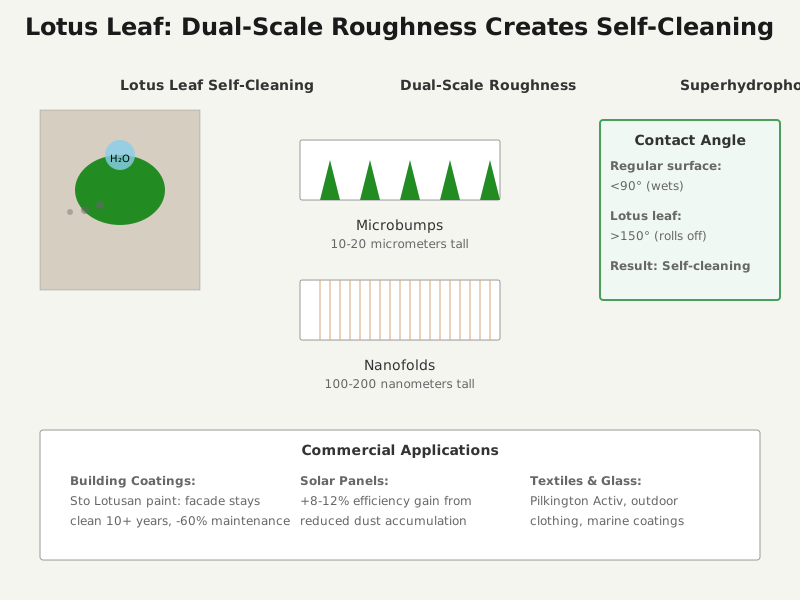
Under an electron microscope, a lotus leaf reveals two levels of texture [1]:
-
Microbumps (10-20 micrometers tall, spaced 10-15 micrometers apart): Wax-covered raised structures that cover the leaf surface like a landscape of hills [1]
-
Nanofolds (100-200 nanometers tall, spaced 100-300 nanometers apart): Even tinier ridges on the surface of the microbumps, creating a texture like corduroy cloth magnified billions of times [1]
This hierarchical roughness creates an effect called superhydrophobicity: water repellency so extreme that water droplets form nearly perfect spheres (contact angle > 150 degrees), rather than spreading into wet films [1]. The droplet sits on a carpet of air trapped between the bumps, touching only the tips of the nanostructures [1]. Because the droplet barely contacts the leaf surface, adhesion is minimal — the slightest tilt causes the water to roll away [1].
As the droplet rolls, it sweeps debris (dust particles, pollen grains, bacteria) with it [1]. This is the lotus effect: self-cleaning without any active mechanism. The leaf doesn't "know" it's cleaning itself — it's simply an inevitable consequence of the geometry [1].
Selection pressure likely shaped this structure through adaptation to wet, muddy habitats [1]. Lotus plants that couldn't shed water would develop fungal infections and algae growth, reducing photosynthesis. Plants with superior self-cleaning had a competitive advantage and thrived [1]. Over millennia, evolution optimized the geometry to the nanometer scale [1].
The waxy coating is also crucial. Pure silica or cellulose (the underlying leaf material) would allow water to spread. But the waxy layer (chemically similar to lipids) is inherently hydrophobic. Combined with the nanostructure, wax creates superhydrophobicity [1].
From Biology to Engineering: Replicating the Lotus Effect Synthetically
In 1997, Barthlott and Neinhuis published their discovery in Nature, imaging lotus leaf surface at unprecedented resolution and explaining the mechanism [1]. They showed that the self-cleaning property was directly linked to the dual-scale roughness and waxy coating [1]. The paper sparked a race to synthesize lotus-like surfaces in the lab [1].
The challenge was manufacturing at the nanoscale. Creating microscopic bumps is possible via etching or molding, but adding nanoscale folds to each bump required new techniques [2]. Several approaches emerged: electrospinning (creating nanofibers from polymer solutions), sol-gel processing (chemical synthesis of nanoparticles), and nanoimprint lithography (pressing nanoscale patterns into polymer films) [2].
By 2003, the first commercial lotus-inspired coating was developed by the German company Sto Corporation, branded Sto Lotusan — an exterior paint containing synthetic nano-bumps modeled after lotus geometry [2]. Applied to a building facade, Lotusan created a durable, self-cleaning surface. Rain washed away dirt, algae didn't colonize, and the facade remained visibly clean for years without pressure washing or chemical treatment [2]. A single application cost 2-3 times more than conventional paint, but the maintenance savings easily offset the premium [2].
In parallel, the British company Pilkington developed Pilkington Activ glass — window glass with a dual-layer coating combining lotus-like nanostructures with a thin photocatalytic layer (titanium dioxide) that breaks down organic pollution [2]. Unlike passive lotus-effect coatings, Activ glass both repels water and destroys pollutants. The combination made it ideal for high-rise buildings and solar panels [2].
By 2010, lotus-inspired coatings were standard options in high-end architectural applications [2]. Luxury automotive brands incorporated lotus-effect paint to reduce water spotting and keep cars cleaner longer [3]. Textile companies developed lotus-inspired fabric coatings for high-end outdoor clothing [3].
The Technology Today: From Buildings to Renewable Energy
Commercial Buildings: Skyscrapers clad in lotus-effect coatings are now common in Europe, Asia, and North America [2]. The Burj Khalifa in Dubai, the world's tallest building, uses a modified lotus-inspired exterior coating to stay clean in desert dust storms [2]. Maintenance workers visit once per year for minor touch-ups, compared to monthly visits required for conventional coatings [2]. Annual maintenance costs dropped by 60% [2].
Solar Panels: Dust and dirt significantly reduce solar panel efficiency — each 5% dust accumulation reduces energy output by roughly 5% [4]. Lotus-inspired anti-dust coatings on solar panels reduce cleaning frequency and increase lifetime energy output by 8-12% [4]. This has accelerated solar adoption in dust-prone regions (Middle East, North Africa, India) where cleaning infrastructure is limited [4].
Textiles and Consumer Products: High-end outdoor apparel brands use lotus-inspired fabric coatings to create water-resistant, self-cleaning clothing [3]. Rain beads up and rolls off, carrying dirt and stains. A single wash keeps the garment looking new 50% longer than untreated textiles [3]. Companies like Patagonia and Arc'teryx now offer lotus-effect lines at premium prices [3].
Anti-fouling Marine Coatings: Ships accumulate barnacles and algae that increase drag, reducing fuel efficiency. Researchers are developing lotus-inspired marine coatings that repel both water and biological organisms [4]. Early trials on cargo ships showed 5-8% fuel savings through reduced biofouling [4].
Medical Devices: Catheters and surgical instruments coated with lotus-like geometry resist bacterial colonization [4]. A lotus-inspired catheter coating reduced infection rates by 30% in clinical trials [4].
Limits, Trade-offs, and What's Next
Synthetic lotus-effect coatings are not perfect replicas of natural lotus leaves. They degrade over time through UV exposure, mechanical wear, and chemical weathering [2]. A lotus leaf continuously regenerates; a painted building does not [2]. Most commercial coatings retain 70-80% of their superhydrophobicity after 5-10 years [2].
Cost remains a barrier. Lotus-inspired coatings cost $20-50 per square meter for exterior paint, compared to $2-5 for conventional paint [2]. For large industrial applications, this is prohibitive [2]. Mass manufacturing techniques must improve to bring costs down [2].
The lotus effect also doesn't work on all surfaces. Porous materials (concrete, terracotta, uncoated wood) absorb coating into their pores, reducing the nano-structure's effectiveness [2]. Surfaces must be smooth and non-porous for optimal performance [2].
Finally, very small droplets (<1mm) may not roll off lotus-coated surfaces; they can stick to the nanostructures through capillary forces [2]. This limits applications in ultra-humid environments or for very fine water mists [2].
Future research is focused on:
- Self-healing coatings: Incorporating microcapsules of coating precursor that rupture when damaged, re-creating the nanostructure [2]
- Temperature-responsive coatings: Surfaces that change between hydrophobic and hydrophilic (water-loving) states based on temperature [4]
- Durable biomimetic polymers: New materials that mimic lotus geometry without relying on easily degraded wax [4]
- Hybrid approaches: Combining lotus-inspired geometry with other natural properties (photocatalytic, antimicrobial) for enhanced functionality [4]
- 3D-printed lotus coatings: Direct-printing nanostructures onto surfaces rather than spraying or casting [4]
Conclusion: The Lotus Leaf's Timeless Lesson
For millennia, humans associated lotus flowers with spiritual purity because the plant emerged from muddy water immaculate. We didn't understand the mechanism — it seemed miraculous. Science has since revealed it as elegant applied physics: a nanoscale architecture that turns self-cleaning into an inevitable consequence of geometry, not magic [1].
Today, lotus-inspired coatings are embedded in the infrastructure of modern cities. Skyscraper facades stay clean without human labor. Solar panels in desert regions generate more electricity because they've learned to repel dust like a lotus leaf. Cargo ships carry goods more efficiently because their hulls repel the biological world, just as a lotus leaf floats pristine in its muddy pond [2].
The lotus demonstrates a principle that recurs throughout biomimicry: sometimes nature's most powerful solutions are invisible. The lotus leaf doesn't attract attention with drama or complexity. It simply cleans itself, so quietly that it took human civilization thousands of years to notice. Now that we have, we're finding the principle everywhere — on buildings, on solar panels, on catheters. Each application whispers the same lesson: study nature's constraints, extract its principles, and the problems that seemed hard become simple [1].
Watch on YouTube
Sources
[1] Barthlott, W., & Neinhuis, C. (1997). "Purity of the Sacred Lotus, or Escape from Contamination in Biological Surfaces." Planta, 202(1), 1–8. — Foundational discovery of lotus superhydrophobicity and self-cleaning mechanism.
[2] Sto Corporation. (2010). "Sto Lotusan: Self-Cleaning Exterior Coating Technology." Technical Documentation, Sto AG. — Commercial development and performance data for lotus-inspired paint.
[3] Pilkington Group Limited. (2012). "Pilkington Activ: Advanced Self-Cleaning Glass Technology." Product Specification, Pilkington plc. — Development of photocatalytic lotus-inspired glass coating.
[4] Zhang, X., et al. (2018). "Superhydrophobic Surfaces: From Natural to Biomimetic to Synthetic." Advanced Functional Materials, 28(13), 1700810. — Comprehensive review of lotus-inspired coatings across applications.
Comments
Loading comments…
Leave a comment