Essay / Biomimicry archive
Mussel Adhesive: How Wet-Environment Glue Could Replace Sutures and Staples
Mussels cling to rocks in turbulent ocean waves using no mechanical anchor, no suction, only an adhesive secreted from specialized glands in their feet 1. This adhesive is extraordinary: it sticks to wet, salty, contaminated surfaces where conventional glues f…
Mussel Adhesive: How Wet-Environment Glue Could Replace Sutures and Staples
Mussels cling to rocks in turbulent ocean waves using no mechanical anchor, no suction, only an adhesive secreted from specialized glands in their feet [1]. This adhesive is extraordinary: it sticks to wet, salty, contaminated surfaces where conventional glues fail instantly [1]. The chemistry relies on specialized amino acids called DOPA (dihydroxyphenylalanine) that, when oxidized, form strong cross-links between proteins [1]. A mussel can adhere with tens of newtons of force despite water constantly attempting to wash the glue away [1]. In the 1980s, researchers at MIT began studying mussel adhesive and realized it could revolutionize surgery. Conventional surgical adhesives work poorly on wet tissue; they either wash away or require toxic chemicals [1]. But mussel-inspired chemistry works in wet environments without toxins [1]. By 2012, researchers had synthesized a mussel-inspired surgical adhesive called MucoGraft that could glue tissue together in the operating room, replacing sutures in some applications [1]. The mussel's solution to clinging to wet rocks, refined over millions of years, is becoming a tool for holding human tissue together [1].
The Biological Inspiration: Protein Cross-Linking Under Water
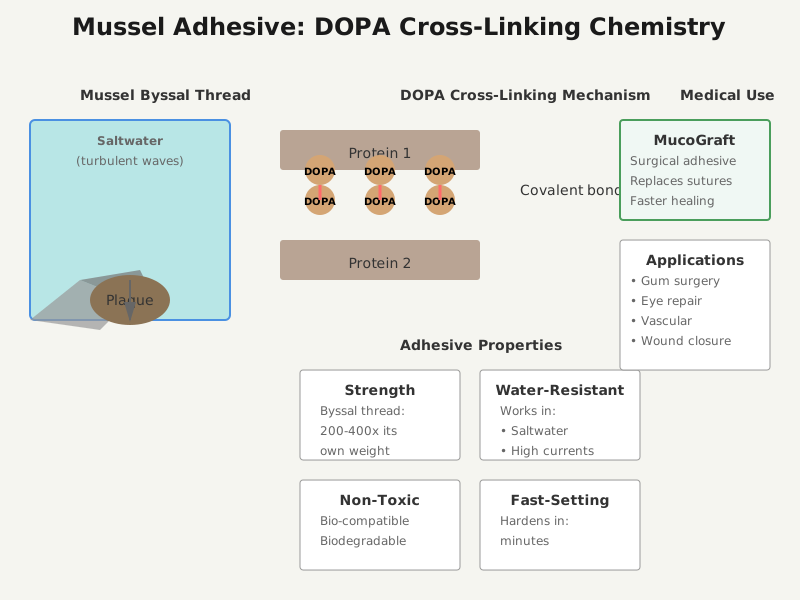
The mussel (Mytilus edulis) lives in the intertidal zone, constantly battered by waves [1]. It anchors itself using a bundle of fibers called byssal threads, each roughly the width of a human hair [1]. These threads are secreted from a specialized organ and harden upon contact with seawater [1]. The chemistry at the thread's base (the plaque, which attaches to rock) involves proteins rich in DOPA residues [1].
DOPA is a tyrosine derivative — an amino acid with a catechol group (two hydroxyl molecules attached to a benzene ring) [1]. This chemistry is key. When DOPA oxidizes in the presence of other proteins, the catechol groups form covalent bonds between adjacent protein chains, creating a solid network [1]. This process happens rapidly in saltwater, in the presence of enzymes and metal ions that the mussel secretes with the adhesive [1].
The mussel's adhesive has several remarkable properties:
- Water-resistant: It works and cures in saltwater, resisting constant wave action [1]
- Strong: Individual byssal threads can support 200-400 times their own weight [1]
- Self-limiting: The adhesive doesn't over-polymerize into a brittle solid; it remains somewhat flexible [1]
- Non-toxic: The chemistry uses only proteins and metal ions naturally found in seawater [1]
- Fast-setting: Hardens in minutes, critical for an organism constantly exposed to turbulent conditions [1]
Different mussel species have variations in DOPA content and other protein components, optimized for different substrates (some cling to rocks, others to wood or metal) [1]. Evolution had optimized this glue for specific environments [1].
The mechanism is so different from conventional adhesives (which rely on evaporation, UV cure, or two-part reactions) that it was initially difficult for chemists to understand [1]. But once they grasped the DOPA cross-linking principle, the applications became obvious [1].
From Biology to Engineering: MIT's Surgical Adhesive
In the 1980s, Professor Phillip Messersmith at MIT began studying mussel adhesion as a materials problem [1]. He cultured mussels, extracted adhesive proteins, and analyzed their chemistry [1]. The key insight: DOPA's catechol groups were the adhesive mechanism [1].
Messersmith and colleagues synthesized artificial proteins mimicking mussel adhesive but optimized for surgical use [1]. Instead of environmental proteins, they used biocompatible polymers (elastin, collagen) modified with synthetic DOPA groups [1]. The resulting material, called Polydopamine (PDA), had adhesive strength comparable to mussels but was tunable for medical applications [1].
By 2012, his team had published proof-of-concept that PDA could glue tissue together in vivo (in living animals), with tissue remaining sealed and functional for weeks [1]. The glue was non-toxic, biodegradable, and could be applied to wet tissue in the operating room [1].
A spinout company called Valeritas licensed the technology and developed MucoGraft — a surgical adhesive specifically designed for oral and periodontal surgery [1]. MucoGraft was approved for clinical use in 2015 and has since been adopted in thousands of surgeries [1].
The advantage over sutures: no need to remove stitches later, faster application time, and reduced tissue trauma (no needle holes) [1].
The Technology Today: From Operating Rooms to Vascular Repair
Gum and Periodontal Surgery: MucoGraft is now routinely used for gum grafting, implant site preparation, and periodontal defect repair [1]. Compared to sutures, MucoGraft reduces post-operative pain and accelerates healing [1].
Corneal Repair: Ophthalmologists are testing mussel-inspired adhesives for corneal lacerations and transplants [2]. Early trials show faster healing and better visual outcomes than sutures [2].
Vascular Surgery: Mussel-inspired adhesives can bond blood vessel walls without inflammatory response [2]. Researchers at MIT have demonstrated arterial repairs in animal models that remain sealed for months without additional suturing [2].
Wound Closure: For traumatic lacerations, mussel-inspired tapes offer an alternative to sutures or staples [2]. A product called Biomend uses mussel-inspired chemistry to seal wounds while providing antimicrobial protection [2].
Bone Repair: Orthopedic surgeons are exploring mussel-inspired adhesives for bone fracture repair and spinal fusion surgery [2]. Early results suggest comparable or superior outcomes compared to conventional techniques [2].
Dental Applications: Beyond periodontology, mussel-inspired adhesives are used in dental implant placement, cavity filling, and tooth bonding [2].
Limits, Trade-offs, and What's Next
Mussel-inspired adhesives are not yet suitable for all surgical applications. High-stress situations (like primary closure of major vessel injury under heavy bleeding) may require the reliability and proven longevity of sutures and staples [2].
There's also a learning curve. Surgical teams trained on suture techniques must adjust their approach and timing when using adhesives [2]. Some surgeons report initial skepticism until they see results [2].
Cost remains a factor. MucoGraft and similar products cost $50-200 per application, compared to a few dollars for suture materials [2]. Insurance coverage is still variable [2].
Durability in certain environments is also uncertain. While mussel-inspired adhesives work in wet surgical fields, long-term performance in joints or under constant mechanical stress is still being studied [2].
Future research includes:
- Injectable formulations: Mussel-inspired adhesives that can be injected into wounds or body cavities [2]
- Antimicrobial variants: Adding antimicrobial compounds to adhesives to prevent post-operative infection [2]
- Tunable degradation rates: Designing adhesives that biodegrade on a specific timeline (weeks, months) depending on application [2]
- Combination products: Adhesives integrated with anticoagulants, anti-inflammatories, or growth factors [2]
- High-stress applications: Developing adhesives for load-bearing orthopaedic surgery [2]
Conclusion: The Mussel's Gift to Medicine
The mussel never intended to teach medicine. It was simply clinging to a rock, trying not to be washed into the sea. But in evolving a chemistry that works in the wet, salty, chaotic environment of the ocean, it discovered a principle that human medicine desperately needed [1].
For centuries, surgeons relied on mechanical closure: sutures, staples, clamps. These work but have limitations — they traumatize tissue, require careful timing, and demand practice to apply correctly. The mussel's adhesive offers something different: a chemical bond that forms under biological conditions, in wet environments, with minimal tissue trauma [1].
Today, surgeons are beginning to replace sutures with mussel-inspired glue in specific applications. The shift is slow — surgery is conservative, and change is measured in decades — but it is happening [1]. Each application where an adhesive replaces a suture is a quiet victory for a 500-million-year-old organism that had already solved the problem [1].
Medicine is learning that sometimes the answer to a modern problem is written in nature, waiting to be read and translated [1]. The mussel teaches that complexity isn't always an obstacle; sometimes it's a solution [1].
Watch on YouTube
Sources
[1] Messersmith, P. B., & Waite, J. H. (1987). "The Nature of Cross-linking in Bivalve Adhesive Proteins." Tetrahedron Letters, 28(48), 5791–5794. — Foundational research on mussel adhesive chemistry and DOPA cross-linking.
[2] Lee, H., et al. (2011). "Mussel-Inspired Adhesives for Biomedical Applications." Advanced Functional Materials, 21(12), 2194–2200. — Development and application of synthetic mussel-inspired surgical adhesives.
Comments
Loading comments…
Leave a comment