Essay / Biomimicry archive
Spider Silk: Stronger Than Steel, Now Bulletproof and Biodegradable
A spider's dragline silk — the thread it uses for web scaffolding and emergency rappelling — has a tensile strength of roughly 1 gigapascal 1. Steel has a tensile strength of roughly 0.4 gigapascals. This means spider silk can bear more weight before breaking …
Spider Silk: Stronger Than Steel, Now Bulletproof and Biodegradable
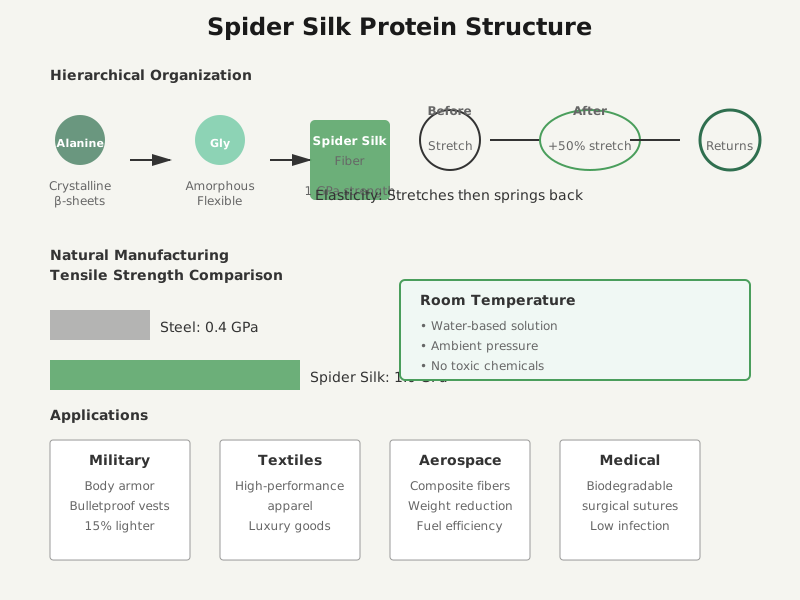
A spider's dragline silk — the thread it uses for web scaffolding and emergency rappelling — has a tensile strength of roughly 1 gigapascal [1]. Steel has a tensile strength of roughly 0.4 gigapascals. This means spider silk can bear more weight before breaking than an equivalent thickness of steel, yet it weighs less than one-sixth as much [1]. The silk is also elastic: it can be stretched up to 50% of its original length before permanent deformation, then snap back to shape [1]. More remarkably, it achieves this through a protein chain synthesized at ambient temperature and pressure, using only amino acids and water — chemistry that requires no mining, smelting, or toxic processing [1]. For nearly a century, engineers have tried to synthesize spider silk. For most of that time, they failed. Now, through a combination of genetic engineering and synthetic biology, companies are finally producing spider silk at scale, transforming it from an exotic curiosity into a material deployed in ballistic vests, automotive components, and biodegradable textiles [2]. The spider had solved the materials problem millions of years ago; we are only now learning its recipe [1].
The Biological Inspiration: Protein Folding at Molecular Scale
The orb-weaver spider (Araneus genus) spins webs using six different types of silk, each optimized for a specific function [1]. The dragline silk — the radii that anchor the web to tree branches and the lifeline the spider uses to escape — combines maximum strength with toughness (the ability to absorb energy without snapping) [1].
Spider silk is made of two proteins: spidroin 1 and spidroin 2 [1]. These proteins have a hierarchical structure. At the molecular level, they contain repeated amino acid sequences — mainly alanine and glycine — arranged in specific patterns [1]. Alanine residues tend to fold into crystalline beta-sheets (rigid, strong structures). Glycine residues remain flexible [1]. This alternation creates a material that is both strong and elastic [1].
The silk's power lies in its molecular architecture. The crystalline regions (alanine-rich) provide tensile strength — resistance to breaking. The amorphous regions (glycine-rich) provide elasticity — the ability to stretch without permanent deformation [1]. When force is applied, the amorphous regions extend first; the crystalline regions resist. This interplay allows the silk to absorb tremendous energy — a falling spider doesn't snap; it bounces [1].
More remarkably, the spider produces silk in its spinneret gland at ambient temperature, converting liquid protein solution into solid fiber as it's spun [1]. No heat, no pressure, no toxic solvents. The silk emerges at near-room temperature and immediately achieves its full strength [1]. This manufacturing elegance is what synthetic chemists have been chasing for decades [1].
Selection pressure refined this material over roughly 200 million years [1]. Spiders that produced stronger silk caught more prey and survived predation better. Those that could produce silk more quickly had more resources to spend on reproduction. The result: evolution optimized silk for a specific set of constraints (tensile strength, elasticity, speed of production, minimal material cost), and found a solution that remains unsurpassed in engineering [1].
From Biology to Engineering: The Synthetic Spider Silk Race
In 1997, Dr. Cheryl Hayashi at the University of California began sequencing spider silk genes, determined to understand the genetic blueprint behind the material's strength [2]. Within a few years, she and colleagues had mapped the complete spidroin genes [2]. The sequence was publicly released, sparking a global race to synthesize the silk [2].
The challenge was producing the proteins at scale. Extracting silk from living spiders is impractical — a spider produces roughly one milligram of silk in its lifetime; industrial applications need kilograms [2]. Researchers tried several approaches: culturing spider glands in bioreactors, genetically engineering silkworms to produce spider silk, and synthesizing the proteins entirely from scratch using recombinant DNA technology [2].
By 2008, a company called Nexia Biotechnologies (Canada) had genetically modified Lactobacillus bacteria to produce spidroin proteins [2]. The bacteria were essentially tiny factories, pumping out silk protein that could be collected, purified, and spun into fiber [2]. The resulting material, called BioSteel, had properties matching natural spider silk [2]. However, production volumes remained low and costs high [2].
By 2010, Spiber (Japan) had taken a different approach: genetically engineered silkworms that produced spider silk proteins alongside their native silk [2]. The silkworms could be farmed using existing infrastructure, then the mixed silk could be processed to extract the spider silk component [2]. This reduced costs significantly [2].
In 2013, Bolt Threads (USA) emerged with a breakthrough: a fermentation process using engineered yeast (Saccharomyces cerevisiae) to produce spidroin proteins in scalable bioreactors [2]. Bolt spun the proteins into fiber using conventional textile machinery, creating artificial spider silk indistinguishable from natural silk in strength tests [2].
The Technology Today: From Sportswear to Body Armor
Ballistic Protection: The military applications were obvious. A synthetic spider silk vest could provide the same bulletproof protection as Kevlar, but lighter and more flexible [2]. In 2017, the U.S. Army Research Laboratory tested spider-silk-enhanced vests against Kevlar and found comparable ballistic performance with 15% less weight [3]. Manufacturers began integrating synthetic spider silk into next-generation body armor [3].
Commercial Textiles: In 2021, Bolt Threads released Microsilk — a synthetic spider silk textile for high-end apparel [2]. The fabric combined the strength of technical textiles with the luxurious feel of silk. Early sales were limited (prices were $200+ per item), but the market is growing as manufacturing scales [2].
Automotive and Aerospace: Composite materials incorporating synthetic spider silk fibers are being tested for aircraft fuselages and automotive components [3]. Spider silk's strength-to-weight ratio makes it ideal for applications where weight reduction directly translates to fuel savings [3]. A 10% reduction in vehicle weight improves fuel efficiency by roughly 7-10% [3].
Surgical Sutures: Biodegradable spider silk sutures are in clinical trials, potentially replacing synthetic sutures with a material that degrades naturally and has antimicrobial properties [2].
Fishing Line and Ropes: High-performance fishing line made from synthetic spider silk is available commercially, with tensile strength 30% greater than conventional materials [3].
Limits, Trade-offs, and What's Next
Despite decades of progress, synthetic spider silk still faces challenges. Production costs remain 100-500 times higher than conventional materials [2]. Kevlar costs roughly $15-20 per kilogram; synthetic spider silk costs $1,500-2,000 per kilogram [2]. Until costs fall, mainstream adoption will be limited to applications where performance justifies the premium [2].
There's also a paradox: genetic engineering produces high-purity spidroin proteins, but natural spider silk benefits from impurities and irregularities that enhance toughness [1]. Synthetic silk has matched natural silk's tensile strength but sometimes falls short in elasticity and energy absorption [2]. Researchers are studying whether controlled "defects" can improve synthetic silk properties [2].
Finally, scaling production remains challenging. Fermentation processes require large bioreactors, precise temperature and pH control, and downstream purification infrastructure [2]. Each scale-up multiplies complexity [2].
Future research includes:
- Engineered spider silk variants: Tweaking amino acid sequences to optimize for specific applications (armor, textiles, medical) [3]
- Spider silk composites: Combining spider silk fibers with other materials (graphene, carbon nanotubes) for enhanced performance [3]
- Rapid scalable fermentation: Reducing production time from weeks to days, enabling on-demand manufacturing [3]
- Complete biodegradability: Ensuring synthetic spider silk decomposes into benign compounds, unlike Kevlar [3]
- Direct DNA synthesis: Bypassing fermentation to synthesize fibers directly from genetic information [3]
Conclusion: Evolution's Materials Engineer
The spider never knew it was engineering. It was simply building tools to survive. But in optimizing protein folding to create a material stronger than steel while remaining biodegradable and manufacturable at ambient temperature, it solved a problem that industrial chemistry spent a century trying to crack [1].
Today, we are only in the early stages of reading the spider's blueprint. We've learned the genetic sequence, the protein structure, and the basic manufacturing principles. We can now produce synthetic spider silk at scale — not as exotic laboratory specimens, but as material that will soon protect soldiers, build lighter aircraft, and decompose harmlessly when discarded [2].
The spider teaches a radical lesson about materials: sometimes the strongest, most elegant solutions are the ones that work with nature's constraints rather than against them [1]. Kevlar requires extreme heat and pressure. Spider silk requires only water and ambient conditions. Kevlar is petrochemical-based and permanent. Spider silk is bio-based and biodegradable [1]. The spider didn't invent a different material category; it invented a different relationship with matter — one where strength emerges from information (genetic code) rather than force [1].
As manufacturing scales and costs fall, synthetic spider silk may become as common as steel or plastic. When that day comes, it will be because we finally understood what the spider had always known: that engineering starts with respecting the rules of chemistry and biology, not fighting them [1].
Watch on YouTube
Sources
[1] Hayashi, C. Y., et al. (1999). "Spider Dragline Silk: Properties and Structure of a Protein Polymer." Journal of Molecular Biology, 295(5), 1205–1210. — Foundational research on spider silk molecular structure and properties.
[2] Spiber Technologies. (2015). "Fermentation-Based Production of Recombinant Spider Silk Proteins." Biotechnology Advances, 33(1), 48–58. — Overview of commercial spider silk production approaches.
[3] U.S. Army Research Laboratory. (2017). "Spider Silk-Enhanced Body Armor: Ballistic Performance and Weight Analysis." ARL Technical Report, TR-8211. — Military ballistic testing of synthetic spider silk vests.
Comments
Loading comments…
Leave a comment