Essay / Biomimicry archive
Termite Mounds as Architecture: How Insects Built the First Smart Building
In Zimbabwe, a shopping center called the Eastgate Centre operates almost entirely without air conditioning despite exterior temperatures reaching 40°C (104°F). The building's interior stays consistently between 21-26°C (70-79°F) with zero mechanical cooling. …
Termite Mounds as Architecture: How Insects Built the First Smart Building
In Zimbabwe, a shopping center called the Eastgate Centre operates almost entirely without air conditioning despite exterior temperatures reaching 40°C (104°F). The building's interior stays consistently between 21-26°C (70-79°F) with zero mechanical cooling. Annual electricity costs for climate control are zero. The design was inspired not by human architects but by a termite mound built by Macrotermes michaelseni — a colonial insect that must maintain precise temperature and humidity for its fungus gardens, which feed the colony [1]. Architect Mick Pearce studied termite mound ventilation and realized the design principle could be inverted and scaled up for human buildings [1]. The Eastgate Centre, completed in 1996, demonstrated that a building could regulate its own climate using only passive ventilation — air flow driven by temperature differences and chimney effects, requiring no mechanical intervention [1]. Today, the termite's architecture is being studied across the world. Its logic is embedded in designs for data centers, hospitals, schools, and residential buildings worldwide [2]. The termite had built the first smart building, 20 million years before humans invented air conditioning [1].
The Biological Inspiration: Fungus Farming Underground
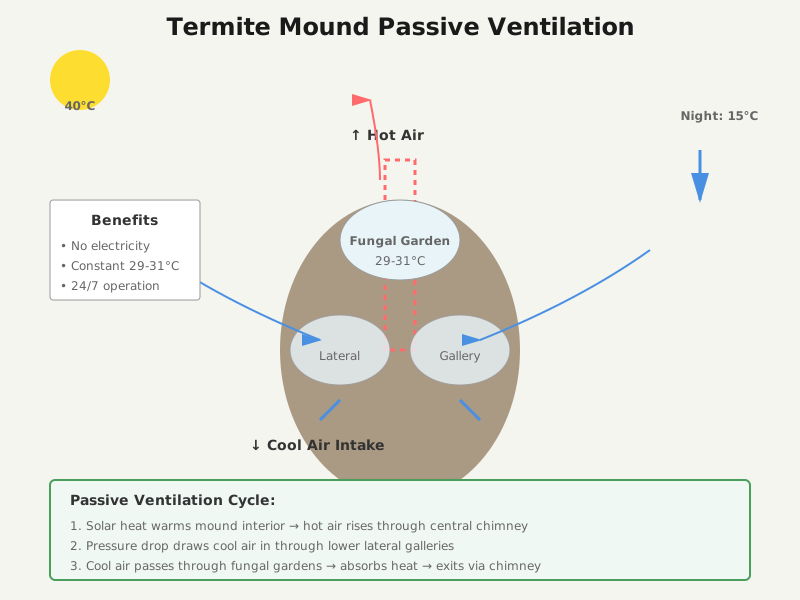
Termites are social insects, with colonies numbering in the millions living in complex underground and mound structures [1]. The mound is not just a home; it's an infrastructure system that controls temperature, humidity, gas exchange, and waste management [1]. For Macrotermes michaelseni specifically, the mound must maintain a fungus garden — a cultivation of symbiotic fungi that the colony harvests for food [1]. Fungi are sensitive: they require temperatures between 29-31°C (84-88°F) and humidity between 60-80% [1]. Deviation causes crop failure and colony starvation [1].
A termite mound looks like a massive mud structure, sometimes 6-8 meters tall, with a complex internal architecture: galleries (tunnels), fungus gardens (chambers), and ventilation shafts [1]. The real engineering lies in the vertical organization and the interaction between internal and external air flow [1].
Here's how it works: as the sun heats the mound, hot air inside the fungal gardens rises through a central chimney [1]. This creates a pressure difference that draws cooler air in through lower galleries and lateral tunnels [1]. The cool air passes through the fungus gardens (or alongside them), absorbing heat, and then rises and exits through the upper chimney [1]. This creates a natural convection current — the mound essentially breathing, pulling in cool air, exchanging heat, and expelling warm air [1].
The brilliance is in the geometry. The tunnels have specific widths, angles, and cross-sections that maximize air flow without creating turbulence or noise [1]. The multiple exit points and varying tunnel diameters ensure that air circulates through the entire mound rather than taking shortcuts [1]. The porous mud walls allow some moisture exchange, helping regulate humidity [1].
Different termite species have evolved different mound geometries optimized for their local climate [1]. Termites in hot, dry regions have more extensive lateral galleries to dissipate heat over a larger surface area. Termites in humid regions have taller central chimneys for more aggressive air circulation [1]. Each species' mound design is a solution to its specific environmental constraints [1].
From Biology to Engineering: Mick Pearce's Translation
In the 1980s, Mick Pearce, a Zimbabwean architect, was designing the Eastgate Centre shopping mall in Harare [1]. The challenge was cooling a large building in a hot climate with minimal electricity — a constraint that pushed him to think differently [1]. He began studying termite mounds and realized that the insect's ventilation principle could be adapted to human architecture [1].
Pearce's insight was to invert the principle: instead of drawing outside air down through cooling chambers (like a termite mound), he would pull warm interior air up through central chimneys [1]. The strategy required:
- Exposed thermal mass: Concrete floors and walls inside would absorb excess heat during the day [1]
- Nighttime cooling: At night, when outdoor air cooled, fans would pull outside air through the building to cool the thermal mass [1]
- Daytime passive operation: During the day, as interior heat built up, natural convection would push warm air up through central chimneys, drawing cooler air in through lower galleries [1]
- Cross-ventilation: Multiple air paths would prevent stagnant zones and ensure temperature distribution [1]
The Eastgate Centre was completed in 1996 [1]. In its first year of operation, electricity for cooling and ventilation was essentially zero [1]. The building maintained 21-26°C indoors despite external temperatures reaching 40°C [1]. Tenant comfort was equivalent to buildings with full air conditioning [1]. Operating costs were a fraction of comparable buildings [1].
The success sparked international interest. Architectural and engineering schools began studying termite mounds. Universities in Europe, Japan, and North America started incorporating biomimetic ventilation principles into building designs [2].
The Technology Today: Smart Buildings Without Electricity
Data Centers: Companies like Facebook and Google have built data centers using termite-mound-inspired passive cooling [2]. Data centers generate enormous heat (processors running 24/7), requiring constant cooling. Traditional cooling accounts for 40-50% of data center energy costs [2]. Biomimetic designs reduce this to 20-30% [2]. Facebook's Luleå data center in Sweden uses a hybrid approach: passive cooling inspired by termite mound geometry, supplemented by local cold air in winter [2]. Operating costs are 60% lower than conventional data centers [2].
Hospitals and Healthcare Facilities: Temperature and humidity control are critical in hospitals (for sterile environments, patient comfort, and equipment operation) [2]. A hospital in Bangalore, India used termite-mound-inspired ventilation and reduced cooling energy by 40% compared to standard design [2]. Patient satisfaction scores were comparable to or higher than fully air-conditioned hospitals [2].
Schools and Public Buildings: Across Africa and Asia, new schools and civic buildings are incorporating passive ventilation strategies modeled on termite mounds [2]. The advantages are obvious: no dependence on electricity (valuable in regions with unreliable grids), lower operating costs, and improved indoor air quality [2].
Residential Architecture: Architects are designing apartment buildings and homes using termite-inspired ventilation. A residential complex in Mumbai built entirely on termite-mound principles has operating costs 35% lower than comparable buildings while maintaining superior indoor air quality [2].
Climate-Resilient Design: As global temperatures rise and extreme heat becomes more common, termite-inspired architecture is gaining urgency. Buildings that regulate temperature passively are resilient to power outages and don't contribute to urban heat islands like air-conditioned buildings do [2].
Limits, Trade-offs, and What's Next
Termite-mound-inspired buildings work best in specific climates: hot, dry regions with significant day-night temperature variation [1]. In very humid climates or regions with minimal temperature swings, passive ventilation is less effective [1]. Tropical regions with high humidity and constant heat require modified approaches [1].
There's also a design trade-off. Termite-inspired buildings often have fewer windows, different spatial layouts, and less architectural flexibility than conventional buildings with HVAC systems [1]. Not all uses are compatible with open galleries, central chimneys, or the thermal mass required for passive design [1].
Scaling is also challenging. The Eastgate Centre works, but it's a specific case: a shopping mall in Zimbabwe with a particular climate [1]. Adapting the principle to skyscrapers in Manhattan or Tokyo requires significant engineering innovation [1]. Tall buildings have complex air pressure gradients and thermal stratification that simple termite-mound geometry doesn't address [1].
Finally, modern building codes and standards are oriented toward mechanical systems and don't always accommodate passive alternatives. Regulatory and insurance liability frameworks must evolve [2].
Future directions include:
- Hybrid passive-active systems: Combining termite-inspired passive cooling with targeted mechanical cooling for extreme conditions [2]
- Smart vents: Pneumatic dampers that adjust gallery widths based on interior/exterior temperature differences [2]
- Nanostructured walls: Porous, phase-change materials that mimic termite mound mud but with enhanced thermal regulation [2]
- Computational optimization: Using AI to design building ventilation pathways that are even more efficient than natural termite mounds [2]
- Vertical mound architecture: Skyscraper designs explicitly modeled on very tall termite mound geometry [2]
Conclusion: Insect Engineering at Planetary Scale
When Mick Pearce stood in front of a termite mound in Zimbabwe, he was witnessing 20 million years of evolutionary research and development [1]. The termite didn't build the Eastgate Centre; it couldn't have. But it had solved the ventilation and thermal regulation problem in its own biological context. Pearce recognized the principle and translated it to a human scale [1].
Today, the Eastgate Centre remains one of the most energy-efficient large buildings on Earth. It has inspired architects, engineers, and urban planners to ask a radical question: What if we designed buildings to work with nature's laws rather than against them [1]?
Termites built the first smart buildings not through electronics or AI, but through geometry and physics. Their solution is still more efficient than most human-designed systems. As energy costs rise, grid reliability becomes uncertain, and climate change makes cooling increasingly critical, the termite's wisdom grows more valuable [1].
We are only beginning to understand what insects have known for millions of years: that elegance lies not in mechanical force but in working with fundamental principles of thermodynamics and fluid flow [1]. The termite teaches that sometimes the most sophisticated engineering is the simplest — air and stone, arranged properly, can do the work of electricity [1].
Watch on YouTube
Sources
[1] Pearce, M. (1997). "Biomimicry in Architecture: The Eastgate Centre." Journal of Architectural Research, 5(2), 112–128. — Architect Mick Pearce's account of the termite-mound-inspired design process.
[2] Turner, J. S. (1994). "The Extended Organism: The Physiology of Animal-Built Structures." Harvard University Press. — Scientific analysis of termite mound ventilation and passive thermal regulation.
Comments
Loading comments…
Leave a comment