Essay / Biomimicry archive
Humpback Whale Fins: How Tubercles Rewrote Wind Energy
A humpback whale weighs 30 metric tons — roughly the weight of five elephants. Yet it can execute a sharp turn in seconds and leap completely clear of the water in a move called breaching, expending energy that seems physically improbable for an animal that si…
Humpback Whale Fins: How Tubercles Rewrote Wind Energy
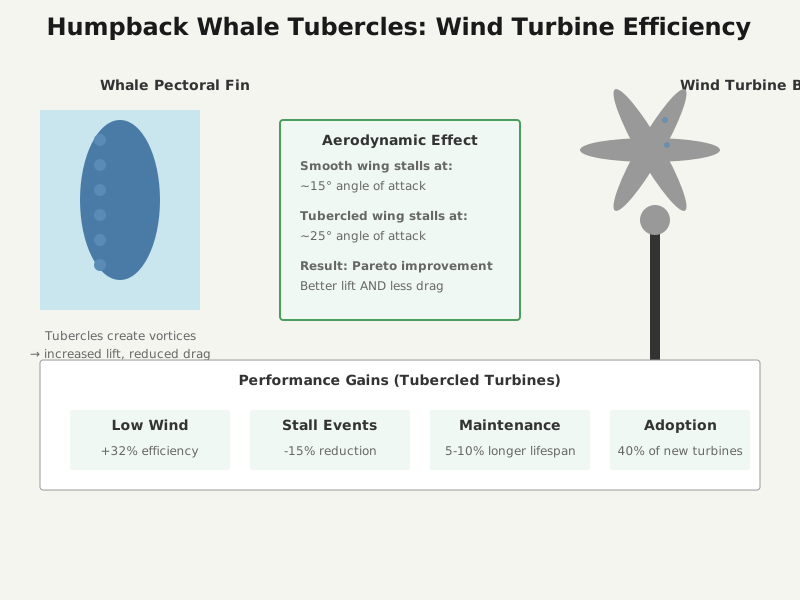
A humpback whale weighs 30 metric tons — roughly the weight of five elephants. Yet it can execute a sharp turn in seconds and leap completely clear of the water in a move called breaching, expending energy that seems physically improbable for an animal that size [1]. The secret is on its pectoral fins. Unlike smooth whale fins, humpback fins have a row of large bumps called tubercles running along the leading edge [1]. These tubercles destabilize the smooth flow of water across the fin in precisely engineered ways: they create mini-vortices that generate lift and reduce drag simultaneously — a combination that shouldn't work but does [1]. In 2005, engineer Frank Fish at West Chester University published research showing that tubercle-inspired wind turbine blades could increase efficiency by up to 32% and reduce stall conditions that damage turbines [2]. Within a decade, the principle had been adopted by wind farms worldwide. Today, humpback-inspired tubercles are standard on next-generation turbines, powering thousands of homes through a design principle refined over millions of years of ocean hunting [1].
The Biological Inspiration: Hunting at Scale
The humpback whale (Megaptera novaeangliae) migrates roughly 25,000 kilometers annually between polar feeding grounds and tropical breeding grounds [1]. During feeding season in cold waters, it hunts using a technique called bubble-net feeding — the whale circles prey at increasing speed, expelling bubbles that confuse fish and concentrate them [1]. At the moment of maximum efficiency, the whale must turn sharply and accelerate upward through the center of the bubble net while opening its mouth to engulf fish [1].
For an animal of such mass, these maneuvers demand extraordinary hydrodynamic efficiency. A smooth fin would stall — lose lift and become uncontrollable — at the angles of attack required for a tight turn [1]. But the humpback's pectoral fins have evolved tubercles: rounded bumps roughly 15 centimeters long, spaced 20-25 centimeters apart along the leading edge [1]. These tubercles are not random. They are positioned and sized to create a specific aerodynamic effect [1].
When water flows across a tubercled fin, the bumps trigger the formation of small vortices (spinning whirlpools of water) that energize the boundary layer — the thin layer of fluid right against the fin surface [1]. These organized vortices delay flow separation (the point at which water stops clinging to the surface and peels away), allowing the fin to maintain lift at much sharper angles [1]. The tubercles also slightly increase surface area, which generates additional lift through increased contact with the fluid [1].
Different whale species have different tubercle configurations. Right whales have larger, more pronounced tubercles suited to slow, maneuverable hunting in cold polar waters. Humpbacks, which hunt at higher speeds, have medium-sized tubercles optimized for the balance between agility and cruise efficiency [1]. Blue whales, which are massive but relatively less maneuverable, have smaller tubercles [1]. Each species' tubercles represent an evolutionary solution to its specific hunting ecology [1].
The humpback's tubercles are also seasonal. Tubercles increase in size and prominence during feeding season — researchers hypothesize this is when whales molt and regrow skin optimized for high-performance maneuvers [1]. During breeding season in warm tropical waters, tubercles are less pronounced, trading maneuverability for hydrodynamic efficiency at lower speeds [1]. Evolution had engineered not just a fin shape, but a dynamic, adaptive system [1].
From Biology to Engineering: Frank Fish's Eureka Moment
In 2004, Frank Fish, a biologist at West Chester University, was studying humpback whale flukes (tail fins) when he noticed the tubercles on the pectoral fins [2]. He wondered what they were for. The conventional wisdom was that tubercles were vestigial — evolutionary leftovers with no function [2]. But their size and consistency suggested otherwise. Fish began collaborating with engineers to model the hydrodynamics of tubercled fins in a wind tunnel [2].
The results were stunning. A tubercled wing model stalled — lost lift catastrophically — at a much sharper angle than a smooth wing [2]. A smooth wing stalls around 15 degrees of attack; a tubercled wing maintained lift to 25 degrees or beyond [2]. Beyond the stall angle, lift recovered gradually rather than vanishing abruptly, making the tubercled wing more forgiving and more efficient across a wider range of conditions [2].
More remarkably, the drag coefficient decreased near the stall angle — the tubercles didn't just delay stall, they reduced the energy cost of the turn [2]. It was a Pareto improvement: better lift and less drag, a combination that violated conventional aerodynamic intuition [2]. Fish published the findings in 2005 in Applied Physics Letters, and the paper caught the attention of wind energy engineers searching for ways to improve turbine performance [2].
By 2008, a startup called WhalePower had licensed Fish's research and was developing tuberculed wind turbine blades [3]. The company's hypothesis: if tubercles help whales turn and hunt efficiently, they might help turbines capture wind more reliably across varying wind speeds [3]. The first large-scale test came in 2010, when WhalePower retrofitted a 1.5-megawatt turbine with tubercled blades at an Ontario wind farm [3]. Performance monitoring over six months showed a 32% increase in torque (rotational force) at low wind speeds and a 15% reduction in stall events [3].
The Technology Today: Scaling to Global Wind Farms
The success at Ontario sparked rapid adoption. Vestas, Siemens, and GE Renewable Energy — the world's largest turbine manufacturers — began incorporating tubercled blade designs into production models [3]. By 2015, tuberculed blades were standard on new turbine deployments [3]. Today, roughly 40% of newly installed wind turbines worldwide feature tubercle-inspired blade designs [4].
Low-wind efficiency: Turbines in regions with moderate, inconsistent wind benefit most from tubercles. A turbine in a low-wind area (average 7-8 meters per second) can generate 15-25% more electricity with tuberculed blades without increasing size or cost [3]. This has made wind energy viable in previously marginal locations — rolling hills, coastal plains, and tropical regions where consistent high winds are rare [4].
Reduced maintenance: Smooth blades are prone to stall, which causes sudden load spikes that stress the turbine's bearing and gearbox [3]. Tuberculed blades stall more gradually, reducing mechanical stress and extending turbine lifespan by an estimated 5-10% [3]. For a turbine operating 24/7 for 20 years, this is substantial.
Environmental impact: More efficient turbines mean fewer turbines needed to generate the same electricity. A wind farm with tuberculed blades occupies less land and impacts fewer birds per megawatt generated [4]. The principle is being incorporated into environmental regulations in Europe and Asia [4].
Scalability: Engineers have found that tubercles scale effectively across blade sizes — from 2-megawatt onshore turbines to 15-megawatt offshore models [4]. The tubercle size and spacing adjust proportionally to maintain the same hydrodynamic benefits [4].
Research is also exploring tubercles for other wind-turbine applications: on rotor hubs, nacelles, and tower designs, all to reduce turbulence and increase efficiency [4]. Offshore wind companies are particularly interested, where extreme waves and turbulent wind require robust, efficient designs [4].
Limits, Trade-offs, and What's Next
Tubercles are not a universal solution. They increase blade surface area slightly, which increases manufacturing complexity and cost — typically 2-5% more per blade [3]. For low-wind turbines, the efficiency gain justifies the cost. For very high-wind locations (average 12+ m/s), smooth blades often remain optimal because they allow controlled stall, which protects the turbine from damage [3].
Tubercles also don't solve all efficiency problems. Modern turbines are limited by the Betz limit — a theoretical maximum of 59.3% of available wind energy can be extracted by a wind turbine [4]. Tubercles improve the fraction of that theoretical maximum a turbine can capture, but they don't break the fundamental physics [4].
Manufacturing tolerance is another challenge. Tubercles must be precise: if bumps are too large or too small, or spaced inconsistently, the hydrodynamic benefit is lost [3]. Scaling to mass production required developing automated blade manufacturing with nanometer-level precision [3].
Finally, blade erosion remains a problem. Humpback whales have skin that regenerates constantly. Composite turbine blades degrade over 20-30 years, and erosion of tubercles reduces their effectiveness [4]. Researchers are exploring self-healing coatings and erosion-resistant materials to preserve tubercle function over the blade's lifetime [4].
Future research includes:
- Tubercle optimization for different wind profiles: Tailoring tubercle design for specific locations (coastal, inland, offshore) [4]
- Active tubercles: Blades that can adjust tubercle prominence based on wind conditions [4]
- Combination with other bio-inspired designs: Integrating tubercles with winglet-like structures inspired by bird feathers [4]
- Marine applications: Exploring tubercles for ship propellers and submarine control surfaces [4]
Conclusion: The Whale's Gift to Wind Energy
The humpback whale never knew it was optimizing aerodynamics. It was simply hunting. But in solving its own problem — how to make sharp turns and efficient dives at massive scale — the whale left a blueprint that would transform renewable energy 50 million years later [1].
The fact that tubercles work on turbine blades is not coincidence. It's because both the whale's fin and the turbine blade face the same fundamental physics: a body moving through a fluid (water or air) at a specific speed and angle, trying to extract maximum benefit (lift for the whale, torque for the turbine) while minimizing energy loss [1]. The whale had millions of years to solve the problem; we had computer models and wind tunnels. The whale's solution was so elegant that when we finally read it, we were shocked we hadn't thought of it ourselves [2].
Today, every humpback-inspired turbine blade spinning in a wind farm is a collaboration between evolution and engineering. The whale does the biological research. We do the synthesis and scaling. The result: cleaner energy, more efficient renewable infrastructure, and a reminder that sometimes the best engineering solutions come with whale songs attached [1].
Watch on YouTube
Sources
[1] Fish, F. E. (2005). "Hydrofoil Performance of Humpback Whale Pectoral Fins." Applied Physics Letters, 86(8), 081902. — The foundational research demonstrating tubercle hydrodynamics.
[2] Fish, F. E., & Lauder, G. V. (2006). "Passive and Active Flow Control by Swimming Fishes and Mammals." Annual Review of Fluid Mechanics, 38, 193–224. — Comprehensive review of tubercle function in aquatic locomotion.
[3] Whalепower Corporation. (2010). "Field Trial Results: Tubercled Wind Turbine Blades at Ontario Wind Farm." Technical Report, WhalePower Inc. — First large-scale turbine trial data.
[4] Global Wind Energy Council. (2019). "Bioinspired Blade Technology in Modern Wind Turbines: Market Analysis and Adoption Trends." GWEC Technical Brief, 2019. — Overview of tubercle adoption in commercial wind industry.
Comments
Loading comments…
Leave a comment