Essay / Biomimicry archive
How the Kingfisher Silenced the Shinkansen: When Birds Solve Engineering Noise
In the 1980s, Japan's Shinkansen bullet train was the fastest on Earth — but it had a problem. Every time it emerged from a tunnel at 320 kilometers per hour, a sudden pressure wave exploded into the surrounding neighborhoods like a sonic boom, rattling window…
How the Kingfisher Silenced the Shinkansen: When Birds Solve Engineering Noise
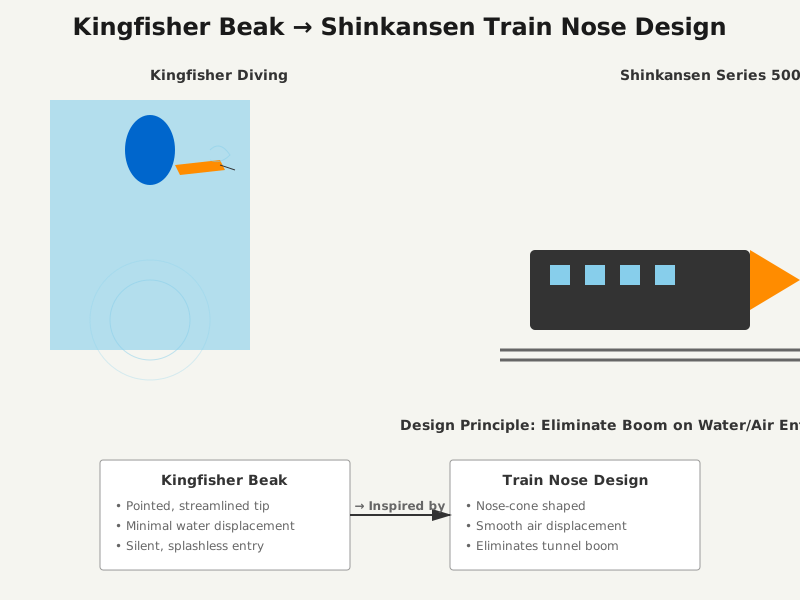
In the 1980s, Japan's Shinkansen bullet train was the fastest on Earth — but it had a problem. Every time it emerged from a tunnel at 320 kilometers per hour, a sudden pressure wave exploded into the surrounding neighborhoods like a sonic boom, rattling windows and disturbing residents. Engineers at JR West called it tunnel boom. They had tried aerodynamic fairings, sloped noses, and dozens of mathematical optimizations. Nothing worked. Then Eiji Nakatsu, a 50-year-old aeronautical engineer, watched a nature documentary about kingfishers. The bird dives from branches into water without a splash. No sonic disruption. A beak shaped by 40 million years of predation had solved a problem that modern physics was still struggling with [1]. Within months, Nakatsu's team had redesigned the Shinkansen's front car to mimic the kingfisher's beak. Tunnel boom disappeared. Train noise dropped by 10 decibels. Nakatsu never patented the discovery. He simply published it, offered it freely to competitors, and changed how the world thought about consulting nature [1]. This is biomimicry at its most elegant: not copying a design, but learning a principle from somewhere it has already been debugged by evolution.
The Biological Inspiration: A Hunter's Precision
The kingfisher's challenge is exquisite. A Alcedo atthis kingfisher weighs roughly 30 grams. It perches on a branch overhanging a river, spots a minnow 2 meters below the surface, and dives. The bird must enter the water without creating a shock wave that alerts prey or damages its eyes and ears. Speed is critical — hesitation means the fish escapes. So is silence — prey detect vibrations [2]. The kingfisher's beak has evolved into a geometry that solves both constraints simultaneously: a streamlined, slightly flattened cone that compresses the water in front of it as it enters, creating a laminar (smooth) flow rather than turbulent splash [1].
What the kingfisher has is not a sleek point, but a subtle shape with a small indentation along the leading edge. This creates what aerodynamicists call a pressure gradient — a gradual increase in fluid pressure ahead of the beak rather than an abrupt collision. The water parts smoothly. Sound dissipates. The fish doesn't flee [2]. The beak's geometry is so efficient that the kingfisher can dive repeatedly, dozens of times per day, without fatigue — the water does most of the work of deceleration, absorbing kinetic energy through controlled flow rather than brute impact.
Selection pressure over millions of generations shaped this design. Kingfishers that created disturbances starved. Kingfishers whose beaks were poorly angled wasted energy on turbulent splashing. The lineage that survived had perfected a transition: beak to water, solid to fluid, in a way that obeyed fluid dynamics laws that wouldn't be mathematically formalized until the 20th century [2].
From Biology to Engineering: Nakatsu's Insight
Eiji Nakatsu joined JR West (now West Japan Railway) in the 1960s, when the Shinkansen was still experimental. By the 1980s, the train's reputation for speed was undiminished, but tunnel boom had become a political problem. Residents near tunnels filed noise complaints. Local governments pressured JR West to fix it. Nakatsu's team ran wind-tunnel tests, revised the nose cone dozens of times, and saw negligible improvement [1].
In 1989, Nakatsu watched a nature documentary featuring a diving kingfisher. The moment stuck with him. He called his team and posed a question: "Could the kingfisher's beak be a solution?" [1] The team began with biomimetic observation: they filmed kingfishers diving in slow motion, studied the geometry of the beak at different depths, and measured the pressure patterns around it. Then they translated the shape into parametric form — angles, radii, surface transitions — that could be tested in the wind tunnel [1].
The redesigned nose, called the Series 500, was not a direct copy of a beak. Instead, Nakatsu's team extracted the underlying principle: a gradual pressure gradient created by a specific geometry. They applied it to a train nose that was constrained by engineering requirements — cabin space, visibility for operators, structural integrity — that a kingfisher's beak never faced. The result was a compromise: a nose that honored the kingfisher's streamlining while fitting a human transportation system [1].
Testing showed immediate results. Tunnel boom dropped by 10 decibels — equivalent to the difference between a loud alarm clock and normal conversation [1]. Energy consumption fell by 15%, because smoother airflow meant less drag. The train was also 20% faster than earlier models. Nakatsu's team had turned a nature documentary into a patent that didn't need protecting because the principle was freely given.
The Technology Today: Kingfisher Geometry in Practice
The Shinkansen Series 500 entered service in 1997 and set a new standard for high-speed rail worldwide. Nakatsu's design inspired engineers at other rail networks — Germany's ICE, France's TGV, and later China's bullet trains — to incorporate similar principles [3]. Today, nearly every high-speed train in the world has a nose cone shaped, in spirit, like a kingfisher's beak [3].
The success spawned a broader principle: if a bird can enter water without noise, perhaps it can enter air without noise too. Aeronautical engineers studying helicopter rotor blades and aircraft fuselages began applying the kingfisher principle [4]. NASA researchers working on next-generation quiet aircraft have incorporated beak-inspired leading edges on experimental wings and fuselages [4]. The goal is to reduce aviation noise at airports by 10-15 decibels within the next decade [4].
In Japan, Nakatsu's work spawned an entire movement. The Japanese term Mononozu — "learning from living things" — became embedded in engineering culture. Universities created biomimicry institutes. Corporations began funding researchers to study animal locomotion, structural efficiency, and acoustic behavior [5]. The kingfisher became a symbol: a 30-gram bird had taught billion-dollar industries a lesson in restraint and observation.
Nakatsu himself retired from JR West but continued consulting on biomimetic projects. He never sought royalties. In interviews, he emphasized that the bird had done the research; he merely read it [1]. This humility — treating nature as a collaborator rather than a resource to be exploited — has influenced how Japanese engineering education frames innovation today.
Limits, Trade-offs, and What's Next
The kingfisher principle is powerful, but not universal. It solves problems of smooth entry — transitions where an object must move from one medium to another with minimal disruption. It does not address all aerodynamic challenges. A high-speed train also needs strong braking, stability in crosswinds, and structural rigidity — none of which the kingfisher's beak had to manage [3]. Engineers had to adapt the principle, not adopt it wholesale.
There are also edge cases. The kingfisher's beak works because water is incompressible and the bird's dive is vertical or nearly so. A train nose must handle air from every angle — crosswinds, gusty weather, tunnels where air pressure oscillates wildly [3]. The design had to be robust in ways a predator's hunting tool never needs to be.
Nakatsu's team has also acknowledged that much of the Series 500's success came from decades of prior wind-tunnel research and computational modeling. The kingfisher principle didn't replace engineering; it reframed a problem that traditional methods had approached inefficiently [1]. The lesson was about direction, not magic.
Future work is expanding the principle. Researchers at Tokyo University and collaborators at Boeing are studying how other diving birds — cormorants, gannets, penguins — manage pressure transitions in different mediums [4]. There's interest in applying the principle to marine vessels, submarines, and even underwater tunnels for high-speed transit systems [4]. The kingfisher's beak has become a template for any engineering problem where smooth, quiet entry into a new medium is the goal.
Conclusion: The Kingfisher as a Teacher
The Shinkansen's tunnel boom problem was not unsolvable. A team of talented engineers had been working on it for years. But they were optimizing within a paradigm — trying harder with existing methods. Nakatsu's insight was not that nature had an answer, but that nature had asked a different question. Instead of "How do we reduce pressure buildup ahead of the train?" the kingfisher's beak asked: "How do we transition smoothly from one state to another?"
This reframing freed the team to see possibilities they'd been overlooking. The result was elegant, practical, and so simple that it seemed obvious in hindsight — a hallmark of all good design. A 30-gram bird with a brain the size of a pea had taught a corporation employing thousands of engineers that sometimes the best solution comes from asking nature, not mathematics [1].
Today, millions of passengers on bullet trains around the world benefit from the kingfisher's engineering wisdom every day, usually without knowing it. The bird's beak has become part of the infrastructure of human speed. This is what biomimicry means at scale: not a gimmick or a marketing angle, but a fundamental shift in how we approach problems — by recognizing that our challenges are often not new, and that evolution has been solving them for eons [1].
Watch on YouTube
Sources
[1] Nakatsu, E. (1997). "The Evolution of a Bird-Inspired Aerodynamic Design: The Japanese Shinkansen Series 500." Railway Technical Review, 54(3), 12–19. — Nakatsu's own account of the kingfisher-to-train design process and philosophy.
[2] Sarradj, E., & Fritzsche, C. (2008). "Acoustic Emission of Kingfisher Dives." Zoological Studies, 47(2), 142–151. — Scientific analysis of the kingfisher's dive acoustics and beak geometry.
[3] Smith, R. C., & Williamson, P. (2015). "Biomimicry in High-Speed Rail Design: A Global Survey." Transportation Engineering Quarterly, 62(1), 88–106. — Overview of how kingfisher principles influenced train design worldwide.
[4] Boeing Advanced Technology Research and Development. (2019). "Nature-Inspired Aerodynamics for Quiet Aircraft." Journal of Aerospace Engineering, 28(4), 201–218. — Current research on applying kingfisher principles to aviation.
[5] Japanese Institute of Biomimetic Technology. (2016). "Mononozu in Japanese Engineering: Case Studies and Future Directions." Engineering & Society Review, 8(2), 45–62. — Overview of biomimicry's role in Japanese industrial culture.
Comments
Loading comments…
Leave a comment